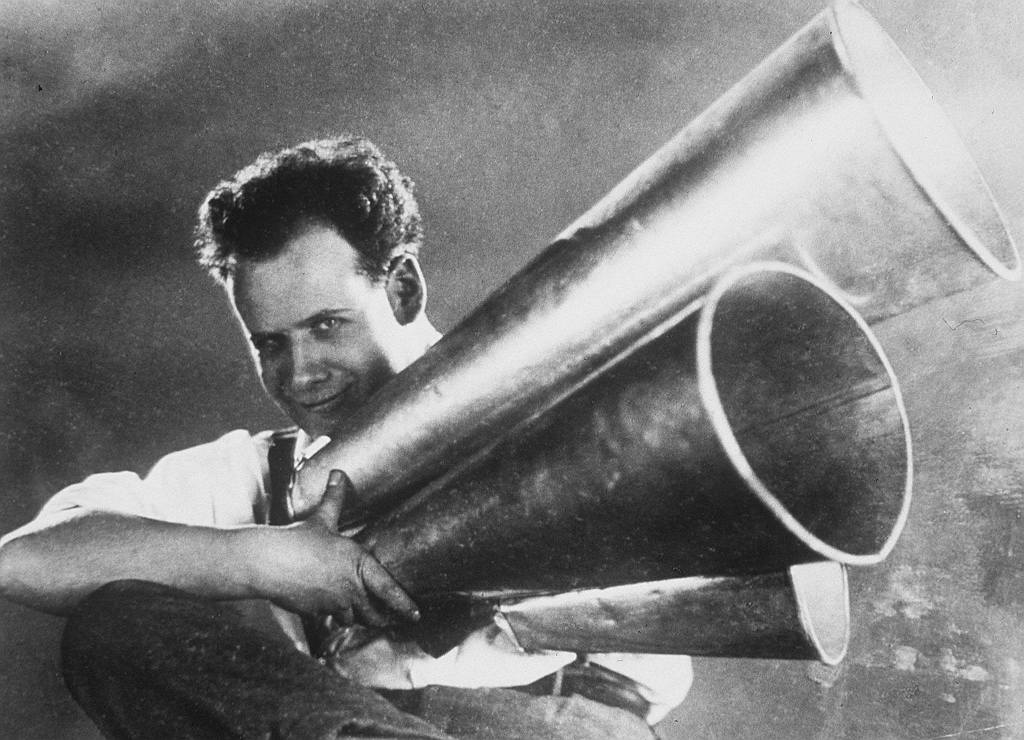
In 2022, we began an ongoing series of lectures and discussions via zoom.
Lotman and Eisenstein
October 21, 2022
Naum Kleiman, Tatjana Kuzovkina, and Yuri Tsivian discussed Lotman’s complicated views of Eisenstein.
Hegel, Eisenstein, and the Rites of Passage: a Polymorphic Idea of Countermovement (Otkas)
November 3, 2023
A lecture by Felix Lenz.
Abstract: The idea of a spherical book was Eisenstein’s method to define montage from different points of view. Likewise, I will try to define the structure of countermovement (otkas) intertwining some theorems of Hegel, Eisenstein, and van Gennep I will advance in eight stages.
1. Eisenstein inherits from Hegel structural bases of „Montage 1938“. Eisenstein’s ideas of a generalised image, the different space-time-characteristics of depiction and generalised image, and the poetical imperative of liveliness are prefigured in Hegel’s Aesthetics.
2. Eisenstein inherits from Hegel the reflection of art under the conditions of modernity. The central structures designs Hegel in his passages about „absolute knowledge“ in Phenomenology of Spirit. The conceptual realm of absolute knowledge operates as modern medium of knowledge of the world. This is the starting point of the thoroughgoing countermovement of „recollection“ as playground for a montage of all pictorial realms of cultural history repeating the emergence of the absolute knowledge again and again. Hegel’s intertwined dynamics of the progression into absolute knowledge and the countermouvement of „recollection“ constitute modernity itself. This is the basis of Eisenstein’s Grundproblem.
3. Hegel’s conclusions for the realm of art are twofold: a) Art expires in collages mixing retro-styles. b) Art masters the conflict between poetical and pictorial thinking of former times and the conceptual thinking of the present. Hegel presents the conflict between modern efficiency and the slowness and richness of art as decisive poetological problem. His two edge cases are lifelessness and mannerism.
4. Eisenstein’s countermovement (otkas) offers a solution: To translate the economy of thought into the anti-economy of action is a way to regain life, and to avoid mannerism. Otkas and montage together solve the poetological problem of modernity. This is the first form of otkas: the know-how.
5. Thought as economical form of the relation to reality is more advanced. The gesture of translation into the anti-economy of action is therefore in itself an operation of going back into an archaic pictorial mode: To realize the rhetorical otkas the artist performs therefore a methodical otkas.
6. The reflection of this procedure produces a third level of the same pattern: the theoretical program of going back into cultural history to advance the aethetics of film. Eisenstein here translates Hegel’s ideas about the conditions of modernity itself into a poetical system.
7. This is framed by a fourth level of otkas: Our progressing modernity balances itself by going back: Hegel went back to the antique, Eisenstein went back with no limits, today we fantasize about a deep time. Otkas is therefore a four-folded thing: It’s the collective performance of a modernity advancing in spirals, it’s an individual subversive anti-economy in the creation and in the performative quality of moving images, and it is the motor of a scholarly program. In this perspective Eisenstein’s Grundproblem provides the center, because it integrates these four dimensions of otkas. Furthermore it reformulates Hegel’s problems of modern poetics into a normative program and it transforms Hegel’s absolute knowledge as reflection of the conditions of modernity into poetical reflections.
8. This stability of otkas under conditions of modernity raises questions. Is it something totally new? Is it a refiguration of a strong tradition in cultural history? Here I include the pattern of rites of passage. First I will show that these rites follow a pattern of otkas. Then I will show that all the phases of the ritual operate in specific atmospheres which follow each other by jumping into the opposite atmosphere. This offers not only a new case of ecstatic dramaturgy, but a bridge between the rhetoric of otkas and essential structures of pictorial, psychological, and narrational development. That way I want to provide a prismatic overview of the different levels of otkas and their interaction.
“Viktor Borisovich was here”: Tracing Shklovsky’s Involvement in Wings of a Serf and Ivan the Terrible
February 2, 2024
A lecture by Maya Garcia.
Abstract: One of Eisenstein’s earliest notes concerning his final film project Ivan the Terrible begins “Viktor Borisovich was here. He feels I must write the scenario myself.” In the years of creation to follow, Viktor Shklovsky remained interested in Eisenstein’s screenplay, offering numerous suggestions both in person and in a formal written review of the completed literary scenario. This review called for extensive revisions and provoked a sharp response from Eisenstein, who began writing a piece titled “Chomp [Огрыз] at Shklovsky” with retorts to his colleague’s particular comments and his general approach to historical fiction film. The collegial argument between the two screenwriters in the early ‘40s has deep roots that are not perceptible from these paper documents, but reveal themselves immediately to the researcher who examines Wings of a Serf (dir. Yuri Tarich, 1926). Shklovsky worked on the adaptation of the scenario (based on a short story by the writer Konstantin Shildkret) for this Sovkino costume drama set at the court of Ivan the Terrible. To trace the creative involvement of Shklovsky in Eisenstein’s film, one must closely examine the documents of the ‘40s in the light of Wings of a Serf, the obvious influence it had on Eisenstein, and the troubled history through which this film went from the talk of the Soviet (and international) cinema press to something left pointedly unnamed. In this talk, I will share my ongoing investigations into Wings of a Serf as a phantom haunting Ivan the Terrible. Much more is at stake than simply the creative relationship between two films: characters and images from Wings of a Serf also haunt personal writings by Shklovsky and Eisenstein in which they contemplate their struggles to remain experimental innovators at the avant-garde of film while facing increasingly harsh pressure to conform to state interests at the end of the 1920s.
A Trip to Tetlapayac (2023, dir. Ian Christie and Chiema Shimada)
April 5, 2024
A film discussion with Ian Christie and Marie Rebecchi.
“In 2012, I managed to visit and film Hacienda Tetlapayac in Mexico where Sergei Eisenstein spent much of 1931, frantically reading and writing, while shooting his revolutionary epic amid the giant maguey plants. Unexpectedly, Tetlapayac remains just as it appears in Eisenstein’s and Eduard Tisse’s footage, having served as a location for a surprising range of films, including several Mexican telenovelas. Indeed, we were only able to piece together the hacienda’s filmic biography long after my visit. And that experience mirrors the current state of Eisenstein scholarship, with researchers still making discoveries like archaeologists among the vast legacy of his manuscripts and drawings. Our film draws on these, following some of the idiosyncratic twists and turns in Eisenstein’s memoir Beyond the Stars. Like this, it has a large cast of characters and references that runs from Douglas Fairbanks as the first screen Zorro, stirring the young Sergei’s interest in cinema, up to Antonio Banderas as his most recent incarnation, also part-filmed at Tetlapayac. Others guest appearances include Leon Trotsky, Spencer Tracy, Serge Daney and Derek Jarman, filming his Imagining October in Moscow with Peter Wollen, just before the start of Gorbachev’s perestroika.” — Ian Christie
 Eisenstein International Network